|
|


|
|
|||||
|
|
 |
|
 |
 |
 |
Menstuff® has compiled information on Prostate Health. Prostate Cancer Awareness Month runs throughout September, and Prostate Cancer Awareness Week is the third full week of September. Newsbytes features the latest prostate cancer news, updated weekly.Newly diagnosed with Prostate Cancer? Click here for a 34 age PDF to hellp.
|
|
Are you a male 40-75
or over 35 and African American
or your father or brother had Prostate Cancer?
Get
tested! PSA and
DRE*
Someone you know may be affected.
One in every six men will get prostate cancer.
35% will be under the age of 65.
There will be over 2.8 million cases of prostate disease reported
each year.
For over 220,800 men, it will be prostate cancer.
Over 27,540 will die because
they didn't get an examination or didn't act soon enough.
Don't let it be said, "He was too afraid or embarrassed to get
tested."
We cannot rest until we win the battle against Prostate
Cancer.
Take
the Risk Factor Test
Four Important Things to Remember before
Getting Tested
1. Be sure that you're rested.
2. No sexual activity for 72 hours before the test.
3. Got a cold? Put it on hold.
4. Either have your PSA test before the DRE or delay taking a
PSA test for 48 hours AFTER you have had your DRE
test.
* If you get a reading between
zero and 1, get tested again in five year.
If the reading is between 1 and 2, get tested again in two years.
If the reading is between 2-4, get tested every year.
If the reading is over 4, consider additional tests like
PSA free, AMAS, ultrasound, x-rays, and more blood t
ests, then, maybe a biopsy. And, take this health opportunity to
learn every thing you can about
prostate cancer! Call the PCA Coalition hotline with questions
about prostate cancer:
888-245-9455
|
|
|
|
|||||
|
|
|
|
|
|
|
About Prostate Cancer - Did You
Know?
The Prostate - The Short
Version
The Prostate - The Long Version:
Prostate Enlargement (Benign Prostatic Hypertrophy)
The Course on Sex & Intimacy For Men
Affected by Prostate Cancer
You Can
Shrink Your Prostate With Massage! Here's How To Do It!
Video 15:39
Early Stage Prostate Cancer
Videos
Sciences proves that ejaculating
more often reduces your risk of Prostate Cancer
Potency after prostate cancer varies
widely
Fatherhood Leads to Drop in
Testosterone
10 Steps to a healthier life and reduced risk of
most cancers
Prostate Cancer Awareness Week Sep Third week in
September
Free Prostate Screenings during
Prostate Cancer Awareness Week
Free Prostate Cancer Treatment for
Some Men in California
Screen Together - Live
Together
Similarity to Breast Cancer
Deaths Per Research Dollar
Spent
Prostate Canceer Awareness Pin
Goodbye Prostate Cancer Awareness
Stamp
Kaiser Permanente Recommends Against
Prostate Screenings
Viagra news coverage concerning discrimination
in insurance payments
Qualifying for Social Security
Disability With Prostate Cancer
Alternative
Treatment and Complementary Medicine 
Prostate
Cancer Prevention
Resources:
For
incontinence
Prostate - Books,
Newsbytes, Links
Impotency - Books,
Information, Links
Merchandising
Materials
Article
Videos
Slide
Guide
Booklet
Webinars
and Videos
Maintaining
a Healthy Lifestyle
Questions
for Your Doctor
Prostate
Cancer News
The major reason all of these major organizations that deal with cancer are not recommending testing is because, unlike breast cancer, they say they haven't found anything that improves or extends a man's life if he gets prostate cancer so, basically, just let it grow. With almost five-times more research spending per death, plus untold millions on awareness, breast cancer cures are seeing great results. At the rate men bought Viagra, you've got to believe they would spend a lot if there was something that could stop prostate cancer without becoming impotent or incontinent. The difference is that women have raised the banners. Have spent their personal time and money to make things happen, have purchased millions of Breast Cancer Awareness Stamps, have made a difference. Unlike women, few men have done any of those things, and while the U.S. Postal Service did creat a Prostate Cancer Awareness stamp, over 50 million of the 78 million stamps sit un-purchased. Will anyone wake up before you get prostate cancer to find a way that helps men live out those final years happier and healthier? Will you?
Note: Spending in 1997 on research looked something like this:
Breast Cancer $12,800/death, prostate cancer $2,700/death.)
About Prostate Cancer - Did You
Know?
10 Steps to a healthier life and reduced risk of
most cancers
2. Add more high-fiber foods - particularly colon cancer. This includes whole grains, fruits and vegetables including peaches, strawberries, potatoes, spinach, tomatoes, wheat and bran cereals, rice, popcorn, whole-wheat bread.
3. Choose foods with Vitamin A. Cancers of the esophagus, larynx and lung. Fresh foods with beta-carotene like carrots, peaches, apricots, squash and broccoli are the best source, not vitamin pills.
4. Do the same for Vitamin C. This could help prevent against cancers of the esophagus and stomach. Grapefruit, cantaloupe, oranges, strawberries, red and green peppers, broccoli, tomatoes.
5. Add weight control. Obesity is linked to cancers of the uterus, gallbladder, breast and colon. Exercise and lower calorie intake help you avoid gaining a lot of weight. Walking is ideal exercise for most people and primes you for other sports.
6. Trim fat from your diet. A high-fat diet increases your risk of colon, prostate and breast cancer (3% of men). Fat-loaded calories mean a weight gain for you, especially if you don't exercise. Cut overall fat intake by eating lean meat, fish, skinned poultry, low-fat dairy products. Avoid pastry, candies.
7. Subtract salt-cured, smoked, nitrite-cured foods. Cancers of the esophagus and stomach are common in countries where these foods are eaten in large quantities. Choose bacon, ham, hot dogs or salt-cured fish only occasionally, if you like them allot.
8. Stop cigarette smoking. It is the biggest cancer risk factor of all - the main cause of lung cancer and 30% of all cancers. Smoking at home means more respiratory and allergic ailments for kids. Chewing tobaccos are harmful, too, as risks for mouth and throat cancers.
9. Go easy on alcohol. If you drink allot, your risk of liver cancer increases. Smoking and drinking alcohol greatly increases risk of cancers of the mouth, throat, larynx and esophagus.
10. Respect the sun's rays. Too much sun causes skin cancer and
other damage to your skin. Protect yourself with sunscreen - at least
#15, wear long sleeves and a hat, especially during midday hours
(11AM-3PM). Don't use indoor sun lamps, tanning parlors or pills. If
you see changes in a mole or a sore that does not heal, see your
physician. Other risk factors: excessive X rays, estrogen's and
work-related exposures to harmful chemicals and fibers like asbestos
are potential risks.
NEW Early Stage Prostate Cancer Videos
 or YouTube
page
(6:54) for more information.
or YouTube
page
(6:54) for more information.Potency after prostate cancer varies
widely
The study found that the answers vary greatly by age, sexual potency before treatment, PSA levels and whether a man has surgery, standard radiation or radioactive seeds.
Using the findings, men can get a rough idea of their personal odds by answering questions that also include weight and race, experts said. Unsurprisingly, older men whose sexual function is already low have the worst chances of good sexual function after treatment.
The federally funded study appears in Wednesday's Journal of
the American Medical Association.
Source: www.aolnews.com/story/study-potency-after-prostate-cancer/1558812/
The Course on Sex & Intimacy For Men
Affected by Prostate Cancer
There is hope: You can have satisfying sexual experiences after
treatment for prostate cancer. Others have done it. You (and your
partner) can, too! The Course on Sex & Intimacy is for you
whether:
Here are details about the 2018 course:
1. Key Features
2. Where and When: June 7, July 5, August 2 (the first Thursdays of those three months) from 7 PM to 8:30 for the first 2 classes, and 7:00 to 9:00 for the third. Meets in the Medical Library (2nd floor) of Marin General Hospital (the same room where the Marin PCa Group meets). Class size is limited to 15 to maximize time for discussion.
3. Requirements: Like the Marin PCa group, the course is free of charge. Unlike the Marin PCa Support group, the Sex & Intimacy class:
a. Requires you to pre-register (the course is not open to drop-ins): The trust that we build in the class is necessary to what we are there to discuss.b. Is for a man affected by PCa only (no partners are eligible to attend): Because men discuss details of their sexual experience, the class is not appropriate for partners.
c. You must plan to attend all 3 classes: Each class builds upon the last, and some of the information has medical significance, so we want everyone to get the full picture.
Please feel free to ask any questions you may have (email us back, or call either of us at the numbers below). We accept registrations on a first-come, first served basis (as of today, we have 10 open seats). If there is an open seat when you say “yes,” we’ll send back registration details.
Regards - Stan & Dick
Dick: 917-494-7880
Stan: 415-290-6060
Here are some comments from previous participants:
Fatherhood Leads to Drop in
Testosterone
So says the first large study measuring testosterone in men when they were single and childless and several years after they had children. Experts say the research has implications for understanding the biology of fatherhood, hormone roles in men and even health issues like prostate cancer.
“The real take-home message,” said Peter Ellison, a professor of human evolutionary biology at Harvard who was not involved in the study, is that “male parental care is important. It’s important enough that it’s actually shaped the physiology of men.”
“Unfortunately,” Dr. Ellison added, “I think American males have been brainwashed” to believe lower testosterone means that “maybe you’re a wimp, that it’s because you’re not really a man.
“My hope would be that this kind of research has an impact on the American male. It would make them realize that we’re meant to be active fathers and participate in the care of our offspring.”
The study, experts say, suggests that men’s bodies evolved hormonal systems that helped them commit to their families once children were born. It also suggests that men’s behavior can affect hormonal signals their bodies send, not just that hormones influence behavior. And, experts say, it underscores that mothers were meant to have child care help.
“This is part of the guy being invested in the marriage,” said Carol Worthman, an anthropologist at Emory University who also was not involved in the study. Lower testosterone, she said, is the father’s way of saying, “ ‘I’m here, I’m not looking around, I’m really toning things down so I can have good relationships.’ What’s great about this study is it lays it on the table that more is not always better. Faster, bigger, stronger — no, not always.”
Experts said the study was a significant contribution to hormone research because it tested men before and after becoming fathers and involved many participants: 600 men in the Cebu Province of the Philippines who are participating in a larger, well-respected health study following babies who were born in 1983 and 1984.
Testosterone was measured when the men were 21 and single, and again nearly five years later. Although testosterone naturally decreases with age, men who became fathers showed much greater declines, more than double that of the childless men.
And men who spent more than three hours a day caring for children — playing, feeding, bathing, toileting, reading or dressing them — had the lowest testosterone.
“It could almost be demonized, like, ‘Oh my God, fathers, don’t take care of your kids because your testosterone will drop way down,’ ” said Lee Gettler, an anthropologist at Northwestern University and co-author of the study, published in The Proceedings of the National Academy of Sciences. “But this should be viewed as, ‘Oh it’s great, women aren’t the only ones biologically adapted to be parents.’
“Humans give birth to incredibly dependent infants. Historically, the idea that men were out clubbing large animals and women were staying behind with babies has been largely discredited. The only way mothers could have highly needy offspring every couple of years is if they were getting help.”
Smaller studies, measuring just snapshots in time, found fathers have lower testosterone, but they could not establish whether fatherhood brought testosterone down or lower-testosterone men were just more likely to become fathers.
In the new study, said Christopher Kuzawa, a co-author and Northwestern anthropologist, having higher testosterone to start with “actually predicted that they’re more likely to become fathers,” possibly because men with higher testosterone were more assertive in competing for women or appeared healthier and more attractive. But regardless of initial testosterone level, after having children, the hormone plummeted.
Scientists say this suggests a biological trade-off, with high testosterone helping secure a mate, but reduced testosterone better for sustaining family life.
“A dad with lower testosterone is maybe a little more sensitive to cues from his child, and maybe he’s a little less sensitive to cues from a woman he meets at a restaurant,” said Peter Gray, an anthropologist at the University of Nevada, Las Vegas, who has conducted unrelated research on testosterone in fathers.
The study did not examine specific effects on men’s behavior, like whether those with smaller drops in testosterone were more likely to be neglectful or aggressive. It also did not examine the roles played by other hormones or whether factors like stress or sleeplessness contributed to a decline in testosterone.
Other studies have suggested, though not as definitively, that behavior and relationships affect testosterone levels. A study of Air Force veterans showed that testosterone climbed back up after men were divorced. A study of Harvard Business School students found that those in committed romantic relationships had lower testosterone than those who were not. Another study found that fathers in a Tanzanian group known for involved parenting had low testosterone, while those from a neighboring culture without active fathering did not.
Similar results have been found in birds and in mammals like marmosets, said Toni Ziegler, a senior scientist at the Wisconsin National Primate Research Center.
Experts say the new testosterone study could offer insight into men’s medical conditions, particularly prostate cancer. Higher lifetime testosterone levels increase the risk of prostate cancer, just as higher estrogen exposure increases breast cancer risk.
“Fathers who spend a lot of time in fathering roles might have lower long-term exposure to testosterone,” reducing their risk, Dr. Ellison said.
Many questions remain. Does testosterone, which appeared to decline most steeply in fathers during their child’s first month, rebound as children become older and less dependent? How often do levels fluctuate?
They did not change before and after a play session with children, researchers found. But do they rise when fathers are at work and decrease on weekends? And are only biological fathers affected, or would similar results occur “if you have an uncle or brother or stepfather living in the household and they care for the baby?” asked Sarah B. Hrdy, the primatologist and author of “Mothers and Others.”
The lowering of their testosterone did not prevent the men in the study from having more children. “You don’t need a lot of testosterone to have libido,” Dr. Kuzawa said.
“If guys are worried about basically, ‘Am I going to remain a guy?’ ” Dr. Worthman said, “we’re not talking about changes that are going to take testosterone outside the range of having hairy chests, deep voices and big muscles and sperm counts. These are more subtle effects.”
And, as Dr. Gray wrote in a commentary accompanying the study,
“The descent of a man’s testosterone may even be welcomed
by some, perhaps his progeny.”
Source: www.nytimes.com/2011/09/13/health/research/13testosterone.html?_r=2&scp=8&sq=prostate&st=cse
The prostate also can be examined by the patient or his partner at six-month intervals in between the regular yearly exam. If indeed you feel a lump, you then have a six-month jump on treatment. This is not talked about a lot because many people have trouble dealing with these parts of the body.
It's easy for a man to feel his own prostate gland. It's a walnut-sized organ at the base of the bladder. It can be felt with the tip of a finger inserted into the rectum. Its texture and firmness should be similar to that of the flesh between your thumb and the rest of the hand when you make a tight fist. If you feel anything that is as firm as the knuckle, then that needs to be brought to a physician's attention.
How you reach the prostate, of course, is up to you. Some men may do the exam in the shower, where soap can be used as a lubricant. This can be a little tricky, because you need to get the palm surface of your finger in contact with the prostate, although the fingernail surface can be used for a cursory examination. You may feel more comfortable if you wear a thin latex glove.
Occasionally, you see hospitals welcoming husbands and boyfriends into their breast self-examination classes. The idea is that perhaps the woman is more likely to get her breast examined if her partner is doing it. The same goes here.
It's not difficult to teach your partner how to examine your prostate gland. Aesthetics aside, this is something every individual couple has to decide if they want to do.
Many men can tell when their prostate is being touched because it's very sensitive. If you're having someone else do it, you'll know immediately when they reach paydirt. If you're doing it yourself, it will also be obvious.
Most folks are surprised by how deep they have to reach. You'd have to have long fingers, indeed, to reach completely to the far end of the prostate gland, but in medicine we are content to touch as much of the surface as possible.
As with breast self-examination, you want to cover all surfaces,
and you should be consistent in how you approach it. Use a sweeping
motion of the finger on one side, and then switch to the other side,
to make sure that you cover as much of the surface as possible.
If you're doing this on someone else, the man can tell you when you've touched the prostate. At that point, feel for the rounded shape and the borders of the prostate, which, as I've mentioned, shouldn't be much larger than a walnut. If it is larger, the man could have enlargement of the prostate gland, which should be brought to a doctor's attention.
Once you establish the outside borders, then make sure your finger touches as much of the in-between tissue as possible. The prostate gland overall is fairly firm, as I mentioned, and you are feeling for any hardness or inconsistency in texture. If any part of it feels harder, bring it to a doctor's attention. If you're not sure, or you have any other questions, mention to your physician that you are doing self-examination or partner examination, and you want to confirm the results.
Remember, this is not to be done as a substitute for a exam by a
physician. Do the self-exam at the six-month interval between your
annual exams.
"Viagra news coverage concerning discrimination
in insurance payments."
1. Covering tests for women for breast cancer and not covering tests for men for prostate cancer. FACT: Almost twice as many men are diagnosed with prostate cancer each year versus women diagnosed with breast cancer. In addition, virtually as many men die of prostate cancer as women who die of breast cancer, and there is no treatment for prostate cancer to date that improves a man’s life.
2. Covering tests for girls for breast cancer and not covering tests for boys for testicular cancer. FACT: 7,200 boys 15-34 will be diagnosed and 350 will die this year from the disease, much greater than girls/women in that age group dying of breast cancer.
Also, a review of the disparage between the amount spent for research and awareness campaigns on the above should be of great interest. The National Cancer Institute estimates that they will spend $332.9 million on breast cancer research this year while spending $74.0 million on the study of prostate cancer and $0 on testicular cancer. Prostate cancer receives the least amount of funding per patient of all major cancers. Source: American Foundation for Urologic Disease.
The National Cancer Institute also reported that during the period 1950-1991, women's rate of death from breast cancer increased 2% while men's rate of death from prostate cancer increased 25%. Until the last few years, you never heard anything about prostate cancer. Even today, it's not a high priority on health programs or the news. There's no postage stamp or brochures at the post office. (The second Breast Cancer postage stamp will soon be issued to raise awareness of breast cancer and to fund additional research.) There’s no special research or funding organizations for prostate cancer, no national prevention month, week or even day.
This is not to say that everything that is being done to find a cure for breast cancer should not be done. However, where do men’s health issues fit in in your local news analysis and reporting? What about the fact that of the 15 leading causes of death, men lead in every single category.
If you’re interested, I’ve included some additional
information on the subject which can be verified with a simple call
to The National Cancer Institute regarding the facts on new
diagnosis, death and research spending. Calls to HMOs, health
insurance carries, etc. will verify the differences in coverage.
This program has become the nation's largest cancer screening program having attracted over 3 million participants. The first year of the program (1989), there were fewer than 100 screening centers in the United States. Today, this number has increased to several hundred locations providing free or low-cost prostate cancer screening with digital rectal examination (DRE) and prostate-specific antigen (PSA) testing.
It’s difficult to come to terms with prostate cancer. Fear of openly discussing the disease; complex treatment decisions; painful side effects - survivors are often left feeling frustrated and powerless. Too often, men face a diagnosis of prostate cancer privately, searching for reliable treatments while hoping for the best. Meanwhile, the disease cuts a devastating path through the lives of hundreds of thousands of men and their families every year. Prostate cancer is the most commonly diagnosed non-skin cancer in the U.S. And is the second leading cause of cancer death (after lung cancer). It affects one out of every five men. A new case is diagnosed every three minutes. If a close relative has prostate cancer, a man’s risk for the disease more than doubles. With two relatives with the disease, his risk increases fivefold. With three relatives, his risk is nearly 100%. In recent years following public activism by AIDS and breast cancer advocates, mortality due to those diseases dropped. But the number of deaths due to prostate cancer will kill 28,900 men this year and more than double the number of deaths due to aids. Support for prostate cancer research lags far behind funding for other diseases.
In 1997, spending on research for every death from the disease looked something like this:
The scarcity of funding for prostate cancer research creates a
vicious cycle. Young and established researchers are drawn to more
profitable avenues of investigation; private enterprise views the
field as too risky for investment; and ideas that might lead to a
cure are conceived but never completed.
Source: CapCure www.capcure.org
This public awareness and education program was conceived and instituted by the Prostate Cancer Education Council (PCEC) which represents urology, oncology, patient advocacy, minorities, clinical and behavioral research. Because of the alarming percentage of men presenting advanced, incurable prostate cancer, the PCED was formed in 1988 to promote awareness, screening and early detection of prostate cancer.
Over 220,900 men will be diagnosed this year and 28,900 will die
because they didn't catch it soon enough. For more information check
out www.pcaw.com
Free Prostate Screenings during
Prostate Cancer Awareness Week
The exams consist of a digital rectal exam (DRE) and a prostate
specific antigen (PSA) blood test, similar to a baseline mammogram
for women, each of which takes about a minute to perform. The
combination of these two methods is the most effective procedure for
detecting prostate cancer at an early and potentially curable stage.
Don’t die of embarrassment. Schedule an appointment for a
screening with your local health care provider.

Screen Together - Live Together

Screen Together - Live Together

Prostate Cancer Awareness Pins
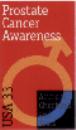
Goodbye Prostate Cancer Awareness
Stamp
Prostate cancer is the second leading cause of cancer deaths in men (after lung cancer) and, excluding skin cancer, is the most common cancer in American men. Early prostate cancer often does not cause symptoms.
Designed by Michael Cronan of San Francisco, Calif., the Prostate Cancer Awareness stamp design incorporates the male symbol. The words "Prostate Cancer Awareness" are stacked at the top of the vertically formatted stamp, "USA 33" appears turned 90 degrees counterclockwise in the bottom-left corner, and stacked in a box positioned in the bottom-right corner of the design are the words "Annual Checkups and Tests."
While the Postal Service does not endorse any particular testing method, the stamp encouraged men who schedule annual physicals or checkups to discuss testing options with their healthcare provider.
For more information on stamps, visit the Postal Service Web site
at www.usps.com
and click "Stamps." To order stamps or stamp products, go directly to
www.stampsonline.com
Technical Details: Issue: Prostate Cancer Awareness; Item Number:
448200; Denomination & Type of Issue: 33-cent Commemorative;
Stamps per Pane/Coil: 20; Print Quantity: 78.1 million stamps; Gum
Type: Self-adhesive.
Qualifying for Social Security
Disability With Prostate Cancer
Receiving A Cancer Diagnosis
When you apply for disability benefits, you have to meet the requirements set forth in the SSA’s own medical guide, which is called the Blue Book. There are standard Blue Book listings for both prostate cancer. The listings specify what requirements must be met in order to receive approval for the condition per the Blue Book. According to the Blue Book, here are the requirements for being approved for prostate cancer.
Qualifying with Prostate Cancer
Prostate cancer is listed under Section 13.24, where it refers to prostate gland - carcinoma. To be approved per the Blue Book, your cancer must meet one of these requirements:
*The SSA lists hormone therapy because it’s a more common treatment for prostate cancer, but if your cancer has returned after chemotherapy you’ll still qualify.
Medical-Vocational Allowance
If you are too disabled to work, but your prostate cancer does not meet the requirements set forth in the Blue Book, you still can be approved for Social Security disability through what’s called a medical-vocational allowance. This is essentially a way to qualify on a case-by case basis, depending on how much physical activity you’re able to do.
When you seek benefits through a medical-vocational allowance, your physician will need to complete a residual functioning capacity (RFC), which details your abilities and your limitations. It is very precise, indicating how long you can stand or sit, how far you can walk, how much you can lift, and what you can carry and how far you can carry it.
All your limitations must be carefully considered, along with any side effects suffered from any treatments or medications. You want to make sure everything is carefully detailed so they can all be considered. Your work experience, any skills that can be transferred, your educational background, age, and RFC are all looked at together to determine whether or not you meet the requirements to receive Social Security disability.
The Application Process for Social Security Disability
When you apply for Social Security disability, you should make sure you have adequate documentation and thorough medical records are detrimental to having a successful disability claim. You will not need to physically mail in your medical records, but be sure to list every hospital where you’ve received treatment so the SSA can gather your medical history on your behalf.
You can either apply entirely online on the SSA’s website, but you can also apply in person by calling the SSA at 1-800-772-1213 and scheduling an appointment for a face to face meeting at your local SSA office.
Helpful Links:
Kaiser Permanente Recommends Against Prostate Screenings
* The Reasons Kaiser gives for not having a PSA test: